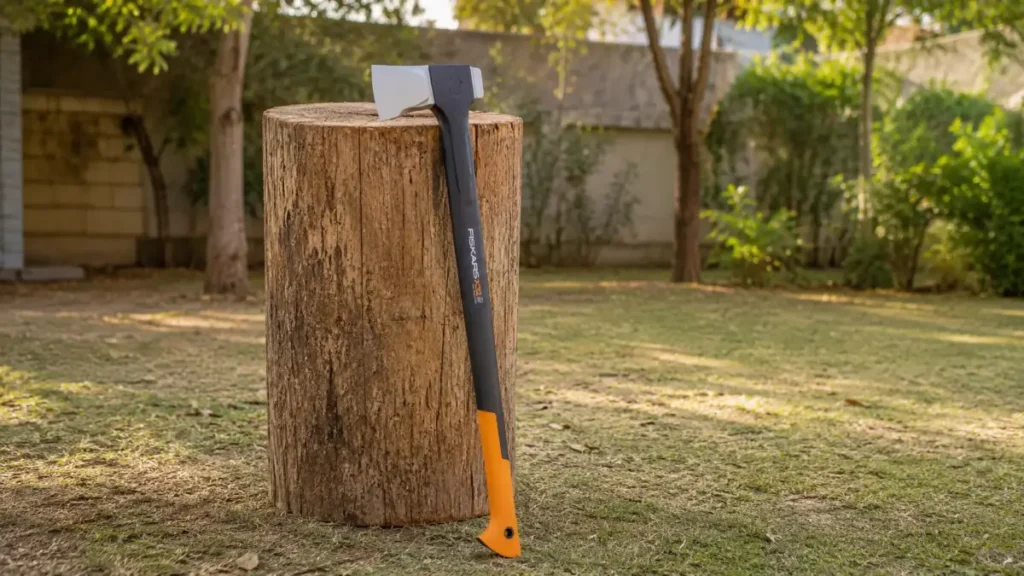
📊 Quick Summary: Fiskars X32 Review: Is This the Best Axe for Splitting Wood?
| Content Type | Hand Tested Review |
| Last Updated | Sunday, July 5, 2026 |
| Fact-Checked By | Azlan – Smart AI Gears Editorial Team |
| Quick Summary | A 3-week hands-on field test evaluating the Fiskars X32's splitting efficiency, wedge geometry, and shock absorption on large backyard logs. |
| Overall Rating | 4.9 |
| Best For | Homeowners processing a regular firewood pile with straight-grained rounds over 12 inches thick. |
| What’s Great | Flawless single-strike splits on medium dry oak, a lightweight FiberComp handle that prevents hand sting, and a blade that stays sharp enough to shave wood curls after heavy use. |
| What’s Not | Demands strict knee-bending form for safety, feels hollow and synthetic compared to hickory, and struggles on dense, heavy hardwood knots. |
| Buy If | You want a fast-swinging, low-fatigue splitting tool that easily releases from stuck logs and comes with a 25-year warranty. |
| Avoid If | You prefer the traditional heavy feedback of a wooden maul or are dealing with lower back and mobility issues. |
| Product Links | |
| Available At | Amazon, and on other online stores. |
View More Review Details
| Tested / Researched By | Elyse A |
| Testing / Research Date | Monday, May 11, 2026 |
| How We Evaluated | Tested for three weeks in a backyard setting, splitting seasoned fir, dry oak, fresh pine, and knotty hardwood rounds ranging from 8 to 18 inches on a sturdy oak chopping block. |
| Main Limitation | The wide wedge geometry can stop abruptly on highly knotted timber rather than slicing clean through. |
| Best Alternative | Heavy 8-pound splitting maul (used as the previous comparison standard). |
Transparency & Editorial Policy
- Affiliate Disclosure: As an Amazon Associate, we earn from qualifying purchases at no extra cost to you. Prices and availability can change, so please verify the latest details on Amazon or the listed retailer before buying.
- Authentic Hand-Tested Review: This review is based on real hands-on product testing, practical use checks, and editorial evaluation.
- AI & Media Usage: AI tools may be used for formatting, clarity, grammar, editing support, or image presentation. AI-generated or edited visuals should be treated as illustrations unless clearly labeled as original hands-on testing photos. Product claims, testing notes, research findings, and final recommendations are reviewed and controlled by our editorial process.
When searching for the best axe for splitting wood, I wanted something that could handle large logs without wearing me out after an hour of work. The Fiskars X32 caught my attention because of its widespread popularity, promising clean, efficient splits on logs over 30 cm.
I tested this axe for several weeks in my backyard, splitting everything from dry oak to fresh pine, tackling both medium-sized rounds and chunky 14-inch logs. I needed to see if the wider blade design and FiberComp handle actually delivered on their claims during real-world use or just sounded good on paper.
This review breaks down its real performance, honest pros and cons, and whether the X32 is genuinely worth your money based on my hands-on testing.
What Is the Fiskars X32 and What Makes It Different?
The Fiskars X32 is the fifth-generation evolution of their splitting axe line, specifically engineered for large logs over 11.75 inches in diameter. At 32 inches in total length, it offers what I found to be the ideal balance of power and control when compared to shorter axes or excessively long mauls.
Choosing the Best Size Axe for Splitting Wood
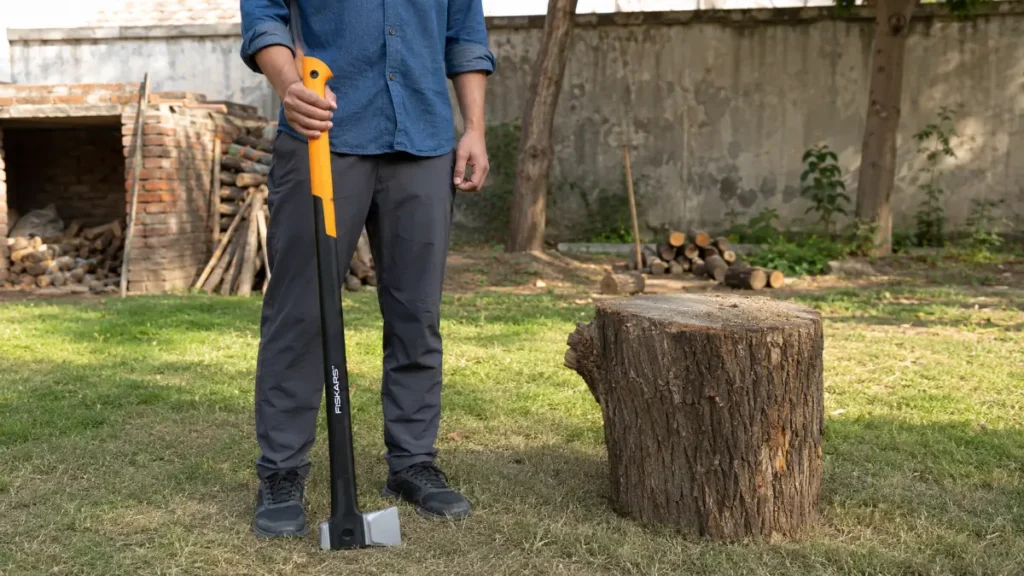
In my backyard testing, finding the best size axe for splitting wood depended on the height of my chopping block and my own reach. At 32 inches, the Fiskars X32 provided an excellent middle ground. It is long enough to generate serious downward velocity, yet short enough to keep my swings highly accurate, minimizing the risk of overstriking.
Key Specifications and Design Features
The axe features a double-hardened forged steel blade that maintained its precision-ground edge beautifully through my repeated impacts. Unlike traditional wooden-handled axes, the X32 uses a FiberComp handle made from fiberglass-reinforced plastic. While Fiskars claims this material is stronger than steel, what I actually felt on the chopping block was a handle that is remarkably light but structurally solid, absorbing heavy vibrations with ease.
The head is insert-molded directly into the handle. This completely eliminates the risk of the head loosening or separating—a frustrating safety issue I have faced multiple times with my traditional wooden-handled tools.
Testing the Best Axe Head for Splitting Wood
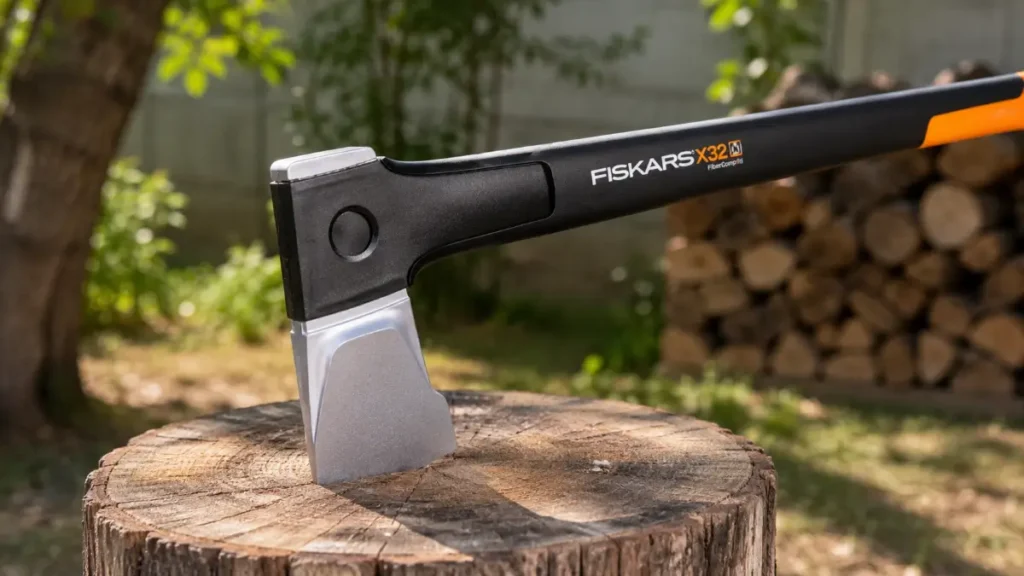
The key difference with the X32 is its wider wedge geometry. The axe head measures 18 cm in length, 6.5 cm in height, and 4 cm thick at the wedge. This broader profile acts as a massive splitting wedge. In my testing, I found that this flare makes it the best axe head for splitting wood when you want to burst fibers open on contact rather than just slicing into them. It physically forces the wood apart aggressively during the swing. The blade also features a low-friction coating designed to reduce resistance as it passes through wood while providing rust protection.
The oversized SoftGrip zone, which is the orange textured section on the handle, takes up significantly more space than previous designs. During my testing, this absorbed shock noticeably better than my old wooden-handled maul, especially on misaligned strikes. The entire axe weighs 2,400 grams (about 5.3 pounds), with a heavy 1,500-gram (3.3-pound) head, optimizing the weight distribution to maximize swing speed and impact force.
Comparing the X32 to My Older Splitting Axe and Maul
In my years of splitting firewood, I have relied on a standard 28-inch splitting axe and a heavy 8-pound splitting maul. Switching to the X32 immediately highlighted how tool geometry affects splitting dynamics.
The wider, taller head profile on the X32 created more efficient splits and made blade removal much easier from stuck logs. The cutting edge sits slightly higher, which gave me noticeably better stability when cleaving hard or knotted wood. Compared to my older, shorter axe, the expanded SoftGrip section on the X32 handle covered much more area, dramatically reducing shock transfer to my hands and improving my grip security during long sessions.
Who Should Consider This Axe
In my experience, this axe is ideal if you are regularly splitting large logs over 30 cm (approx. 12 inches) in diameter. It worked wonderfully for my daily firewood preparation and clearing fallen trees on my property.
However, because of the 32-inch length, I had to be very conscious of my form, making sure to bend my knees when splitting logs on the ground. If you have lower back issues or struggle with mobility, you might find this tool a bit demanding.
Real-World Testing: Splitting Performance on Different Log Sizes
I spent three weeks splitting firewood in my backyard to see how the X32 performs. My testing pile was diverse, featuring seasoned fir, dry oak, fresh-cut pine, and several knotty hardwood rounds ranging from 8 inches to 18 inches in diameter.
Testing Setup and Wood Types Used
I set up a dedicated workspace with a sturdy oak chopping block, though I placed the heaviest, most stubborn rounds directly on packed dirt to split them at ground level. This setup let me test the axe’s capabilities across a variety of realistic cutting heights.
Performance on Medium Logs (8-12 Inches)
On medium-sized logs between 8 and 12 inches, the X32 performed flawlessly. Dry oak and seasoned ash split cleanly, almost always in a single, satisfying strike. Fresh pine required two swings due to the wet, sticky moisture content, but the splits remained straight and highly predictable.
Performance on Large Logs (Over 12 Inches)
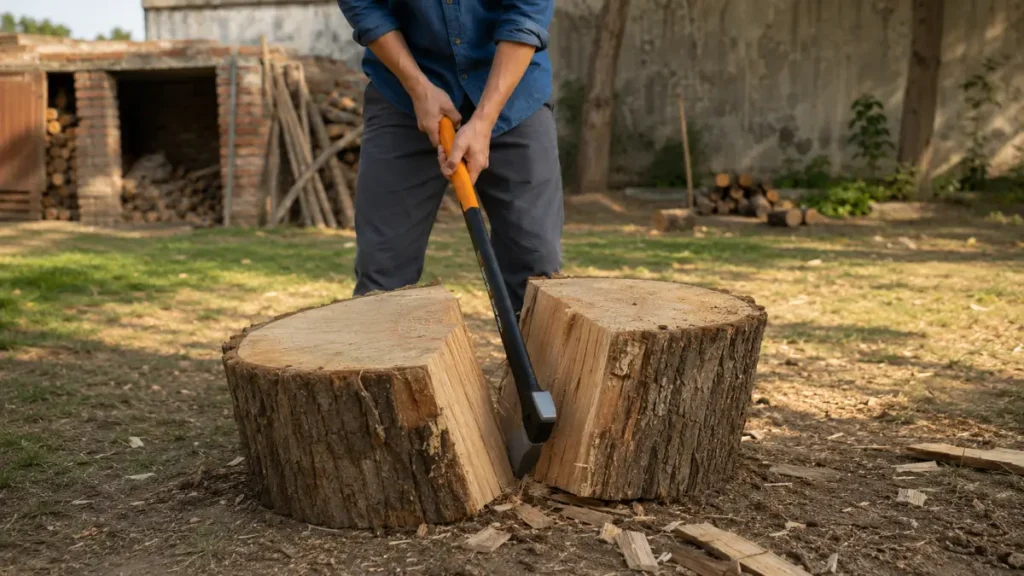
For logs over 12 inches, the performance varied depending on the wood type. Straight-grained hardwood rounds at 14-16 inches typically split in two strikes. When testing the axe on seasoned white oak, I was highly impressed to find that the blade stayed sharp enough to shave fine wood curls even after I had split more than 20 large logs. Knotty pieces over 12 inches were much tougher, taking anywhere from three to five full swings to completely separate.
What is the Best Axe for Splitting Wood for Homeowners?
If you are trying to figure out what is the best axe for splitting wood for your homestead or backyard firewood pile, the key is balancing weight, swing speed, and wedge angle. After weeks of testing, I believe the X32 strikes that balance perfectly.
In reality, true one-strike splits only happened on straight-grained, dry logs under 14 inches. Larger rounds consistently required two to three precise swings. Fresh, wet pine typically took me two hits due to its moisture content, while dense, knotty hardwoods required multiple strikes. The marketing claims about “one-strike” splits really only apply to ideal, seasoned, straight-grained wood, not a typical, irregular wood pile.
Does the Blade Get Stuck or Come Out Easy?
The wider blade design made removal transitionally easier than my old splitting maul. Even when I embedded the blade deep in a tough, twisted oak grain, a slight wiggle was all it took to free it. I rarely had to resort to flipping the entire log over and slamming the back of the axe head against the chopping block to break it loose.
Low-Friction Coating: Does It Really Work?
The low-friction coating reduced resistance as advertised. Wood fibers slid off the head smoothly, and I noticed less sticky pitch buildup when splitting fresh pine compared to my older uncoated steel axes.
Build Quality, Handle Comfort, and Balance
How the 32-Inch Length Feels During Swinging
For my average height, 32 inches proved to be the best length axe for splitting wood. It gave me enough leverage to generate massive downward speed, without making the tool feel clumsy. Compared to my old 36-inch maul, the X32 swings much faster and allows me to hit my targets with better accuracy.
FiberComp Handle: Shock Absorption and Grip Quality
With a total weight of 2,400 grams and a heavy 1,500-gram head, the lightweight FiberComp handle shifts almost all the balance directly to the blade. While I have only tested it over a span of several weeks, the fiberglass-reinforced handle felt incredibly rigid and lightweight, absorbing impact vibrations far better than my old wood-handled maul.
The expanded SoftGrip zone dampened shock beautifully. During my longest splitting sessions, I felt virtually none of the hand fatigue or palm sting that usually plagues me when using a steel-handled splitter. The textured grip stayed completely secure even when my hands got sweaty, though if you prefer an ultra-tacky grip, you might want to wrap the handle with grip tape for heavy, multi-hour use.
Forged Steel Blade: Sharpness and Durability After Use
The double-hardened forged steel blade arrived incredibly sharp right out of the box. After splitting roughly 20 dense logs, the edge maintained its integrity without needing any honing or touch-ups. I noticed some superficial scratches on the low-friction coating, but the underlying steel showed absolutely no rolls, chips, or functional wear.
Weight Distribution and Overall Balance
While some traditionalists prefer a heavy, 8-pound wooden maul, I found this 32-inch, 5.3-pound setup to be the best full size axe for splitting wood if you want to work for hours without intense muscle strain. The balance point sits perfectly for controlled strikes, making repeated swings much less tiring than using my older, heavier mauls.
Pros & Cons
Pros
- Aggressive Splitting Power: The wider wedge geometry explodes straight-grained logs apart with incredible efficiency.
- Minimal Sticking: The blade shape and low-friction coating make freeing the axe from stubborn logs effortless.
- Low Impact Fatigue: The FiberComp handle and SoftGrip dampening mean zero hand sting, allowing me to split over a cord of firewood in a single weekend without waking up sore.
- Manual Satisfaction: It is efficient and satisfying enough that I preferred using this manual tool over firing up a loud hydraulic splitter.
- Solid Warranty: Knowing it has a 25-year warranty gave me confidence that I could swing it hard without worrying about breaking the handle.
Cons
- Demands Good Form: The 32-inch length requires disciplined, knee-bending form; a careless swing could easily end up dangerously close to your shins or feet.
- Synthetic Feel: The hollow polymer handle, while strong, can feel slightly cheap and resonant to those who love the organic, heavy feel of a hickory wood handle.
- Struggles on Heavy Knots: On highly knotted timber, the wide wedge sometimes stopped abruptly rather than slicing clean through.
- Premium Price: The price point sits in the premium range, which might make it a tough sell for casual, budget-conscious users.
Who Should Buy the Fiskars X32
I highly recommend this axe to anyone regularly processing large firewood, particularly rounds over 11.75 inches. If you value durability and a low cost-per-swing over the years, I found that this axe delivers exceptional value.
Who Should Skip This and Look Elsewhere
I’d suggest skipping this if you prefer the traditional feedback of wooden handles, or if you are primarily splitting smaller kindling. If you have lower back issues or struggle with mobility, a shorter tool or a hydraulic splitter might be a safer fit.
Is It Worth the Price After Real Use?
From my testing, the X32 fully justifies its price tag through its sheer durability and low impact on the body. It takes the physical punishment out of splitting firewood, making it a stellar long-term investment.
Conclusion
After splitting dozens of logs in my backyard, I can confidently recommend the Fiskars X32 for anyone looking for a reliable, highly efficient splitting tool. The wider wedge design splits straight-grained logs beautifully, particularly rounds over 12 inches where this axe truly shines. The FiberComp handle absorbs shock better than my old wooden maul, vastly reducing overall hand fatigue.
The price sits higher than standard wooden axes, but the 25-year warranty and outstanding ergonomic design justify the investment for anyone serious about processing their own firewood.