📊 Quick Summary: Milwaukee 3692-22CT Review
| Content Type | Hand Tested Review |
| Last Updated | Friday, July 10, 2026 |
| Fact-Checked By | Azlan – Smart AI Gears Editorial Team |
| Quick Summary | A data-driven, hands-on review analyzing the real-world performance benchmarks, runtime limits, and ergonomic realities of the Milwaukee 3692-22CT combo kit. |
| Overall Rating | 4.6 On Amazon |
| Best For | Homeowners, serious DIYers, and service trades like electricians, HVAC technicians, and maintenance crews. |
| What’s Great | Highly compact footprints, excellent power-to-weight ratio, all-metal drill chuck, and a dual-voltage charger. |
| What’s Not | Drill lacks a concrete hammer function and the impact driver is a single-mode tool with no electronic speed switch. |
| Buy If | You need a compact, durable 18V tool kit for tight spaces, overhead tasks, and light-to-medium trades work. |
| Avoid If | Your daily production routine requires heavy masonry drilling, large-diameter hole saws, or continuous structural timber fastening. |
| Product Links | |
| Available At | Amazon and on ACME, But on ACME tools its out of stock |
View More Review Details
| Tested / Researched By | Azlan – Smart AI Gears Content Manager |
| Testing / Research Date | Thursday, June 11, 2026 |
| How We Evaluated | Evaluated through 4 weeks of workshop testing recording exact drilling speeds via digital tachometer, casing temperatures via infrared thermometer, and structural fastening thresholds. |
| Main Limitation | The compact CP2.0 batteries drain quickly under heavy, high-demand workloads and make the lightweight tools top-heavy when clipped to a tool belt. |
| Best Alternative | Milwaukee M12 FUEL (3497-22) for compact masonry work, or Milwaukee M18 FUEL (3697-22) for heavy-duty production. |
Transparency & Editorial Policy
- Affiliate Disclosure: As an Amazon Associate, we earn from qualifying purchases at no extra cost to you. Prices and availability can change, so please verify the latest details on Amazon or the listed retailer before buying.
- Authentic Hand-Tested Review: This review is based on real hands-on product testing, practical use checks, and editorial evaluation.
- AI & Media Usage: AI tools may be used for formatting, clarity, grammar, editing support, or image presentation. AI-generated or edited visuals should be treated as illustrations unless clearly labeled as original hands-on testing photos. Product claims, testing notes, research findings, and final recommendations are reviewed and controlled by our editorial process.
Where to Buy
Milwaukee 3692-22CT
Buy Options
Quick Verdict & Target Audience
- Verdict: Outstanding value for tight spaces, overhead tasks, and light-to-medium trade work. Across my light-to-medium drilling and fastening tests, the 3692-22CT handled most routine homeowner and service-trade tasks without making the heavier M18 FUEL kit feel necessary.
- Best For: Homeowners, serious DIYers, and Service Pros (electricians, HVAC technicians, facilities maintenance).
- Skip If: You are a structural framer or commercial contractor requiring continuous high-torque driving, large-diameter hole sawing, or daily concrete drilling.
Testing Setup & Repeatability Methodology
To ensure the reproducibility of these benchmarks, the testing was conducted under the following standardized parameters:
- Timeline: 4-week testing window (June 11, 2026 – July 8, 2026).
- Environment: Unconditioned workshop. Ambient temperature ranged from 80°F to 84°F, averaging approximately 82°F. Ambient readings were taken immediately before starting each test.
- Equipment Used: Tachometer readings verified with a Neiko 20713A Digital Photo Tachometer. Tool casing temperatures were measured with a Klein Tools IR1 infrared thermometer. Readings were taken from approximately 6 inches away, keeping the target area centered on the same marked point for every test.
- Temperature Location & Limits: For the drill, surface temperatures were recorded on the plastic motor housing directly over the motor/stator area, exactly 10 seconds after the final repetition of each test series. For the impact driver, surface temperatures were recorded on both the plastic motor/stator housing and the aluminum front impact-mechanism housing. These figures represent external housing temperatures, not internal motor, battery-cell, or electronic-component temperatures.
- Battery State: Unless noted, all tests initiated with a fresh, 100% fully charged 2.0Ah CP battery. Comparative tests (CP2.0 vs. XC5.0) were performed on adjacent sections of the exact same lumber to eliminate density variance.
- Materials Used:
- Kiln-Dried SPF lumber (11% to 13% moisture content verified via pinless moisture meter).
- Stacked 2x4s and 2x12s (SPF).
- 3/4-inch oak hardwood planks (7% to 9% moisture content).
- 1/4-inch A36 mild steel plate.
- Consumables: Brand-new Milwaukee Shockwave Red Helix cobalt drill bits (twist tests), new Irwin Speedbor spade bits (spade tests), and a brand-new Diablo 2-1/8-inch bi-metal hole saw.
- Fastener Prep: Lag screws (1/4-inch x 4-inch Grip-Rite) driven into pre-drilled 5/32-inch pilot holes (exactly 3 in deep) with a standard flat steel washer; no thread lubricant. Structural screws (5/16-inch x 4-inch GRK Rugged Structural) driven directly without pilot holes or lubricant.
Kit Breakdown & Crucial Clarifications
Included Components
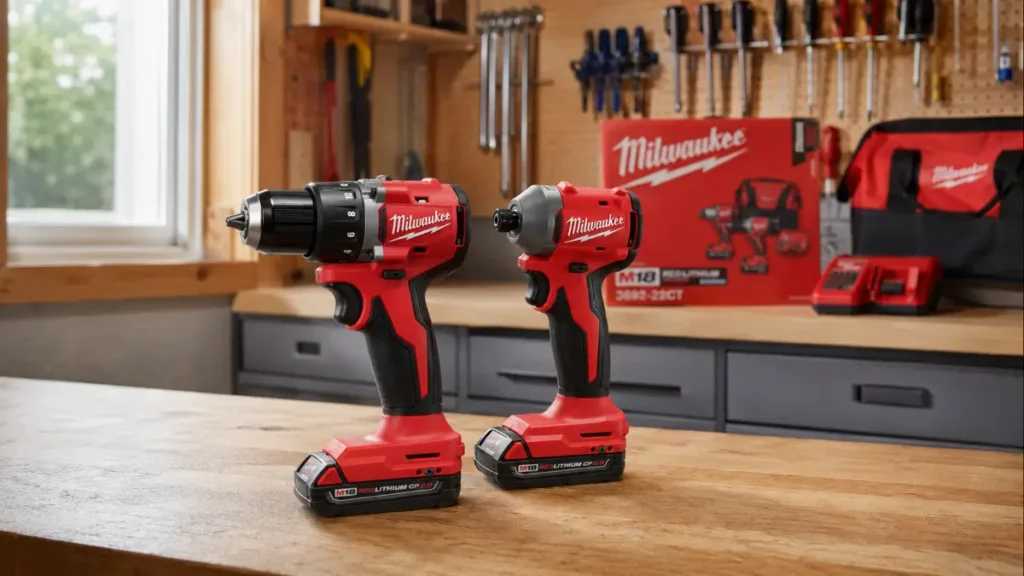
- 3601-20 Compact Brushless 1/2-inch Drill/Driver
- 3650-20 Compact Brushless 1/4-inch Hex Impact Driver
- Two M18 REDLITHIUM CP2.0 Batteries (slim, single-stack, 2.0Ah)
- M12/M18 Multi-Voltage Charger
- Contractor Bag (soft-sided canvas)
Crucial Product Distinctions
- Not M18 FUEL: These tools use brushless motors and REDLINK overload and temperature protection, but they do not use Milwaukee’s POWERSTATE-branded motor system or REDLINK PLUS control platform and lack features such as AutoStop and selectable drive modes found in the premium FUEL models.
- No Hammer Function: The 3601-20 is not designed for regular concrete or masonry drilling. For brick, block, stone, or concrete work, use a hammer drill or rotary hammer.
Weight & Dimensions
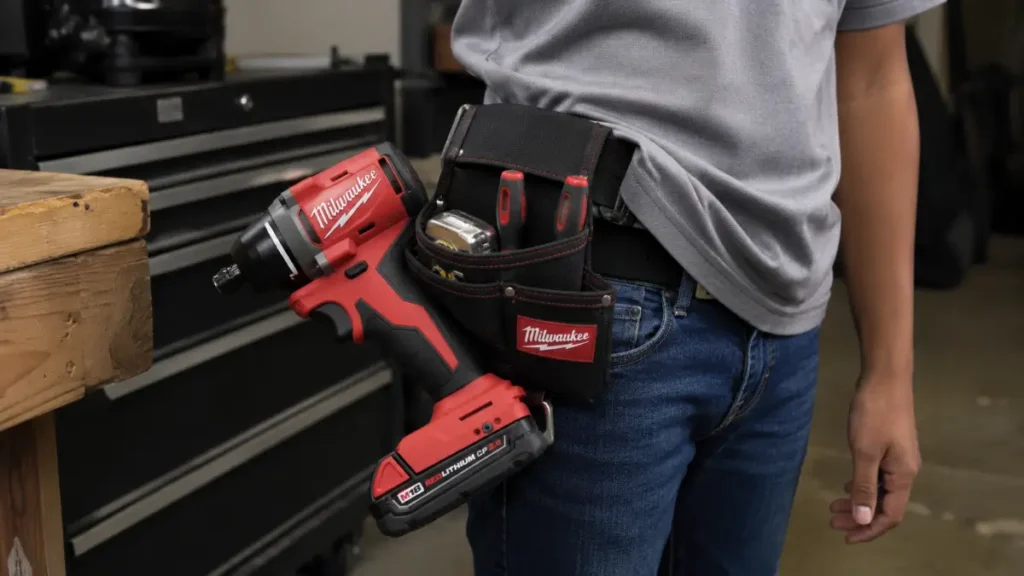
Note: Clipping these lightweight tools to a tool belt with the CP2.0 battery installed makes them top-heavy, causing them to lean outward.
3601-20 Drill/Driver: Measured Benchmarks
Measured No-Load Speed (Tachometer Verified)
- Gear 1: 538 RPM (Claimed: 550 RPM)
- Gear 2: 1,682 RPM (Claimed: 1,700 RPM)
Performance Metrics
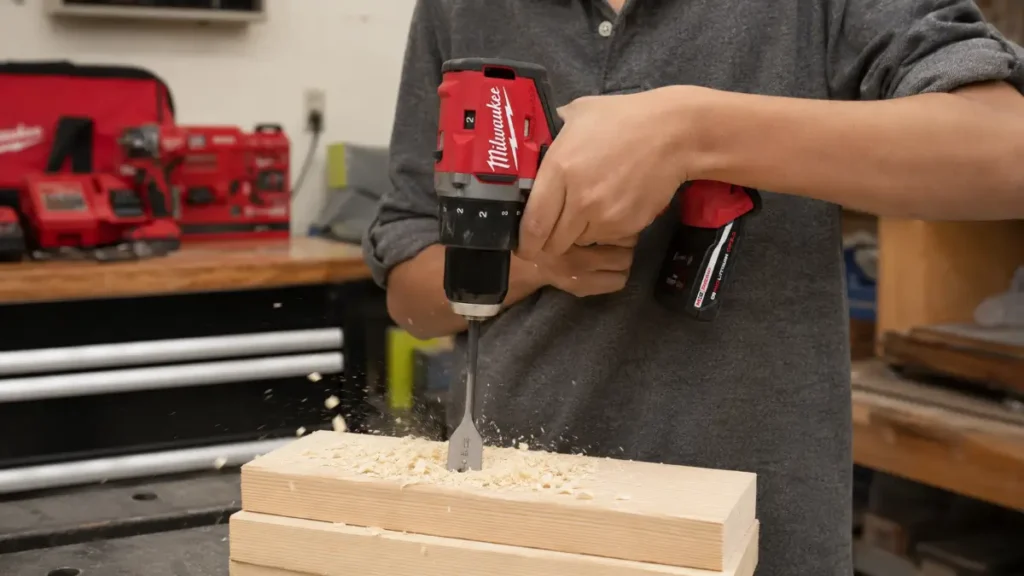
- Chuck Retention & Runout: No visible runout was observed during testing; the bits appeared to spin true. Runout was not measured with a dial indicator. Over 20 consecutive forward/reverse drilling cycles, zero bit slippage or chuck loosening occurred.
3650-20 Impact Driver: Fastening Matrix
- Max Torque Rating: 1,700 in-lbs
- Max Speed: 3,600 RPM | 4,900 IPM
- Control Note: Single-mode only. No electronic speed selector on the foot. The 3650-20 is a single-mode impact driver with a variable-speed trigger; power modulation relies 100% on trigger finger control.
Fastening Test Performance
Battery Performance & Charging Data
Mixed-Load Output Before Reaching One Remaining Battery Bar
- Endurance Output: Starting from a full charge, the single CP2.0 battery completed exactly 84 half-inch holes (in oak hardwood using the 1/2-inch twist bit) plus 62 standard 2-1/2-inch wood screws (into SPF) before the fuel gauge dropped to one remaining bar.
- Full-Discharge Charge Time: In a separate full-discharge charging test (discharged to automatic tool cut-off), the CP2.0 battery required exactly 42 minutes to reach the charger’s solid-green indication using the included multi-voltage charger.
CP2.0 vs. XC5.0 Comparative Upgrade Test
Upgrading to an M18 XC5.0 battery yields immediate performance shifts (tested on adjacent sections of the same lumber):
- Stall Prevention: Completely eliminated Gear 2 stalling with the 1-inch spade bit.
- Speed Output: Reduced driving time of 5/16-inch structural screws from 11.2 s down to 8.5 s.
- Thermal Control: During the ten-screw structural-fastener test, the impact driver’s measured motor-housing surface temperature was 15°F lower with the XC5.0 battery than with the CP2.0 battery. This temperature difference applied only to this specific repeated-fastening test and should not be interpreted as the XC5.0 always making the tool run cooler.
- Ergonomics Penalty: Shifts the tool balance point heavily to the bottom, noticeably increasing wrist and overhead fatigue.
Pros & Cons
Pros
- Shorter head lengths (5.7" drill / 4.4" impact) slip into narrow stud bays and tight cabinet corners effortlessly.
- Delivers impressive torque (550 in-lbs / 1,700 in-lbs) while keeping total tool weight under 3.2 lbs.
- The 1/2-inch metal chuck provides rock-solid bit retention with zero slippage or visible runout during heavy cycles.
- The included unit charges both M12 and M18 batteries, saving valuable outlet space on the job site.
- Offers roughly 85% to 90% of the daily capability of the premium FUEL line at a fraction of the cost.
Cons
- Limited strictly to wood and metal drilling; cannot handle concrete, brick, or masonry work.
- Lacks an electronic speed selector pad, forcing you to rely 100% on your trigger finger for delicate fastening.
- The lightweight, slim battery packs drain quickly under heavy loads like hole saws and structural lags.
- Because the CP2.0 battery is so light, the tools become head-heavy and tilt outward when clipped to a tool belt.
Core Tool Comparisons
Comparison
| Tool Model | Drill Max Torque | Impact Drive Modes | Tool Length (Drill) | Target Workload |
|---|---|---|---|---|
| Milwaukee 3692-22CT (Brushless) | 550 in-lbs | Single-Mode (Trigger) | 5.7 inches | Light-to-Medium Trade / DIY |
| Milwaukee 3497-22 (M12 FUEL) | 400 in-lbs | 4-Mode Selector | 6.0 inches | Compact Masonry / Pro Service |
| Milwaukee 3697-22 (M18 FUEL) | 1,400 in-lbs | 4-Mode Selector | 6.9 inches | Heavy-Duty Heavy Production |
1. Milwaukee M18 Compact 3692-22CT vs. M12 FUEL (3497-22)
- Torque: M18 Compact leads with 550 in-lbs vs. M12 FUEL’s 400 in-lbs of drill torque.
- Footprint: Contrary to what the 12V label may suggest, the M18 Compact tools are actually shorter in official measurements (e.g., the 3601-20 drill is 5.7 in while the 3404-20 M12 FUEL drill is 6.0 in).
- Design & Control: The M12 FUEL kit’s main advantages are its hammer-drill capability, four-mode impact control, and compact battery platform.
- Ecosystem: M18 Compact provides immediate entry to the broader, higher-capacity M18 battery system.
2. Milwaukee M18 Compact 3692-22CT vs. M18 FUEL (3697-22)
- Size: The FUEL hammer drill (3697-22 kit) is noticeably longer (6.9 in vs. 5.7 in) and heavier, making it more demanding to use overhead. However, the impact drivers have nearly identical head lengths (4.47 in vs. 4.4 in), though the FUEL impact is heavier and offers more torque, four-mode control, and better low-speed management.
- Cost: The FUEL kit usually carries a substantial price premium, although actual pricing varies significantly with retailer promotions.
FAQs
Is this kit part of the Milwaukee FUEL line?
No. These tools are from the standard Compact Brushless line. They do not use Milwaukee’s POWERSTATE-branded motor system or REDLINK PLUS control platform and lack features such as AutoStop and selectable drive modes found on M18 FUEL models.
Can I drill into concrete with this drill?
Although a small hole in soft masonry may be possible with the correct masonry bit, repeated concrete drilling will be slow, inefficient, and unnecessarily demanding on the tool. For regular stone, concrete, or brick block work, use a hammer drill or rotary hammer.
Can the impact driver handle automotive lug nuts?
No. This tool is a 1/4-inch hex driver designed for wood screws, self-tappers, and light lags. It cannot reliably break loose automotive lug nuts; a dedicated 1/2-inch impact wrench is required.
What is the difference between this and the 3651-20 impact driver?
The 3650-20 is a single-mode impact driver with a variable-speed trigger. The 3651-20 adds three selectable electronic drive modes for better control over speed and power.
What is the manufacturer warranty on this kit?
When purchased through authorized dealers, Milwaukee provides a 5-year limited warranty on the tools and a 2-year limited warranty on the included CP2.0 batteries.