📊 Quick Summary: Best Work Boots for Concrete in 2026: Pit Boss vs. Overpass
| Content Type | Review Without Hand Testing |
| Last Updated | Monday, June 29, 2026 |
| Fact-Checked By | Azlan – Smart AI Gears Editorial Team |
| Quick Summary | A head-to-head comparison between Timberland PRO Pit Boss and Wolverine Overpass work boots to find the best option for standing or walking on concrete floors. |
| Overall Rating | Timberland 4.4 | Wolverine 4.4 |
| Best For | Industrial, warehouse, and trade workers spending long hours on hard concrete surfaces. |
| What’s Great | Timberland offers superb static standing support and durability; Wolverine provides instant sneaker-like comfort and high flexibility. |
| What’s Not | Timberland has a brutal 2-week break-in and heavy weight; Wolverine has weak stock insoles and faster sole wear. |
| Buy If | You need maximum arch support for standing in one spot (Timberland) or zero break-in time for constant walking and crawling (Wolverine). |
| Avoid If | You cannot tolerate heavy boots and blisters (skip Timberland) or you stand all day without upgrading factory insoles (skip Wolverine). |
| Product Links | |
| Available At | Amazon, listed retailers |
View More Review Details
| Tested / Researched By | Azlan |
| Testing / Research Date | Monday, June 1, 2026 |
| How We Evaluated | Evaluated based on official specifications, verified buyer feedback, expert sources, video demonstrations, and common user problems. |
| Main Limitation | Evaluation is completely research-based without original direct hands-on testing data or original testing photos. |
Transparency & Editorial Policy
- Affiliate Disclosure: As an Amazon Associate, we earn from qualifying purchases at no extra cost to you. Prices and availability can change, so please verify the latest details on Amazon or the listed retailer before buying.
- Review Without Hand Testing: We did not personally hands-on test this product. This review is based on product specifications, verified buyer feedback, expert sources, video demonstrations, and common user problems to help readers make a more informed decision.
- AI & Media Usage: AI tools may be used for formatting, clarity, grammar, editing support, or image presentation. AI-generated or edited visuals should be treated as illustrations unless clearly labeled as original hands-on testing photos. Product claims, testing notes, research findings, and final recommendations are reviewed and controlled by our editorial process.
If you have spent more than five minutes standing on a bare concrete slab, you already know the truth. Concrete does not give a damn about your joints, and finding the best work boots for concrete is your first line of defense.
After a ten-hour shift on a warehouse, factory, or workshop floor, that solid ground sends every single shock wave straight up your heels, through your knees, and right into your lower back. Choosing the right footwear isn’t about looking tough; it’s about survival. A boot that feels great in the showroom can feel like a pair of cinder blocks by hour eight.
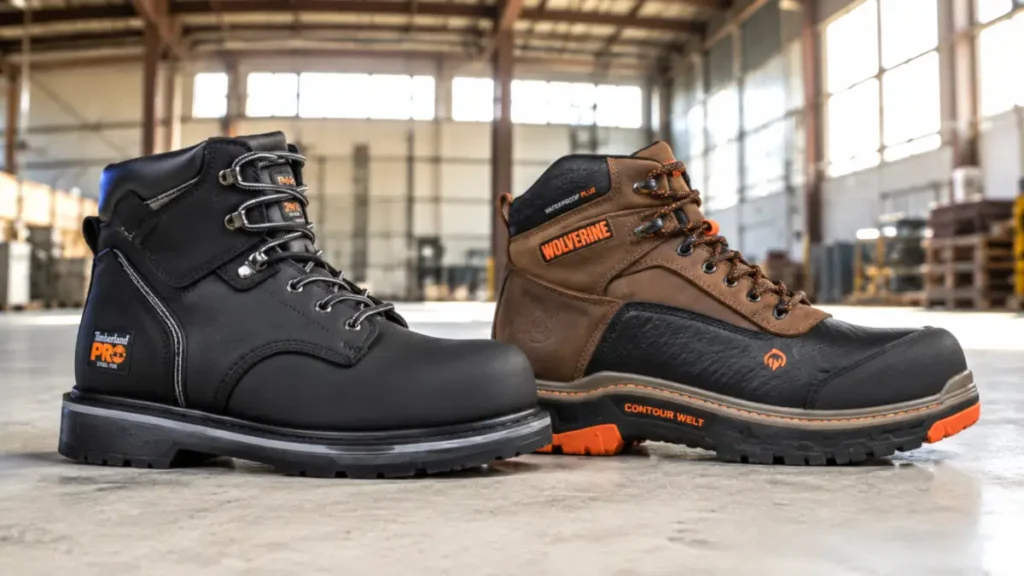
Today, we are putting two of the most popular contenders head-to-head on the hard stuff: the Timberland PRO Men’s Pit Boss 6-Inch Steel Safety Toe and the Wolverine Men’s Overpass Composite Toe Waterproof Work Boot. Based on extensive data and long-term feedback from workers on unsealed workshop floors and slick warehouse aisles, we have broken down exactly how these two stack up. One of these is an old-school tank that requires some patience; the other is a modern, flexible hybrid.


Quick Verdict: Best Work Boots for Concrete
Quick Verdict: Best Work Boots for Concrete
| Feature | Timberland PRO Pit Boss | Wolverine Overpass |
|---|---|---|
| Tested Weight, Size 10 | 2.18 lbs per boot | 1.68 lbs per boot |
| Safety Toe Material | Steel | Composite |
| Out of Box Comfort | Brutal, expect blisters | Excellent, sneaker like |
| Break In Period | 14 to 18 hard working days | 2 to 3 days |
| Best for Standing Still | Winner, superb arch base | Lacks long term stock support |
| Best for Kneeling or Crouching | Stiff, bites into ankle | Winner, excellent flex point |
| Sole Durability | Exceptional, high density TPU | Average, prone to early cracking |
| Waterproofing | Water resistant leather | Fully waterproof membrane |
Timberland PRO Pit Boss vs Wolverine Overpass: Concrete Floor Scores
This scorecard shows where each boot performs better for concrete-floor work. Timberland wins for long standing and durability, while Wolverine wins for flexibility, first-day comfort, and wet-floor movement.
Long standing comfort
First-day comfort
Flexibility
Durability on concrete
Waterproofing
Heat control
Overall concrete rating
Scores are based on practical concrete-floor review notes and use-case comparison.
Break-In Timeline: Pit Boss vs Overpass
The Timberland PRO Pit Boss needs more patience, while the Wolverine Overpass feels easier much sooner.
Timberland PRO Pit Boss
- Day 1 to 3: Stiff and hard
- Day 4 to 7: Leather starts softening
- Day 8 to 14: Comfort improves
- Day 14 to 18: Proper break-in feel
Wolverine Overpass
- Day 1: Easier first wear
- Day 2 to 3: Short break-in feel
- Day 4 and after: Mostly ready for regular use
Which Boot Should You Buy for Concrete Floors?
Choose the boot based on your work style. Standing-heavy jobs favor Timberland, while movement-heavy jobs favor Wolverine.
1. Timberland PRO Men’s Pit Boss 6-Inch Steel Safety Toe
The Timberland PRO Pit Boss is an absolute tank of a boot. It is built the old-fashioned way: thick, heavy, oil-tanned leather, a solid steel toe, and a chunk of dense rubber underfoot.
If your daily grind involves standing in one place for hours or walking miles on rough, high-friction slabs, this boot is designed to take that abuse. However, it demands a major sacrifice upfront.
The Break-In: A Two-Week Rite of Passage
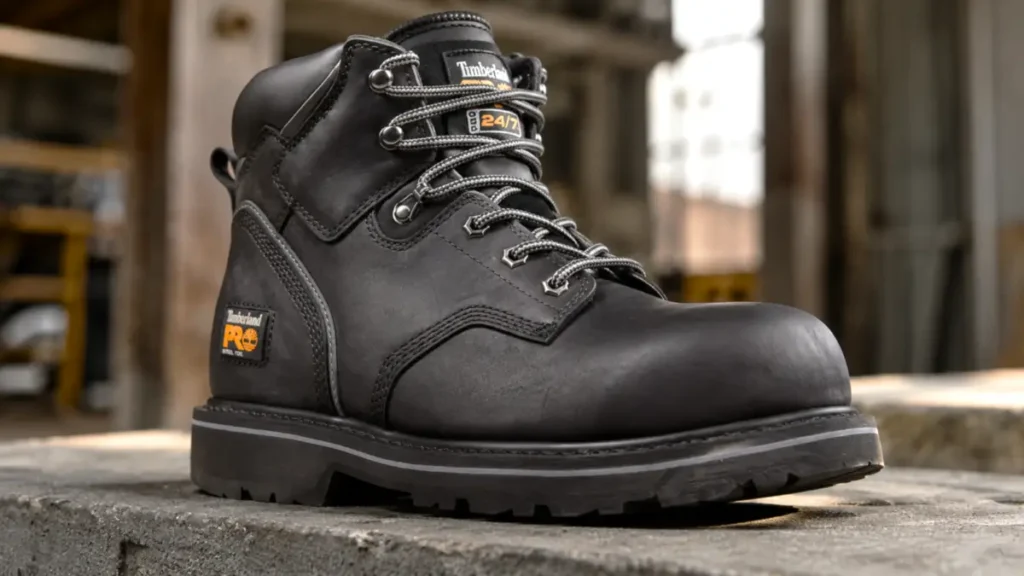
Let’s not sugarcoat it: the first week in the Pit Boss is miserable. Official specifications clock these at 2.18 lbs per boot for a size 10. That is a lot of dead weight to swing around if you are not used to it. User data consistently highlights that during the first few days on a raw concrete floor, the stiff leather collar bites hard into the ankles, and the steel toe cap feels restrictive. If you buy these, do not wear them for a full shift on day one.
Bring a backup pair of shoes to the shop. Expect a solid 14 to 18 days of regular wear before the leather finally yields and molds to your foot shape.
Performance on Concrete
Once you get past that brutal break-in phase, the Pit Boss transforms into one of the best work boots for standing on concrete. The magic lies in Timberland’s integrated PU (polyurethane) midsole and their open-cell polyurethane footbed.
Unlike soft foam that bottoms out under heavy pressure, this dense suspension system absorbs vibrations continuously. When standing on hard floors, the boot feels incredibly stable and planted.
It does not flex easily, which is actually a benefit for static standing because it keeps your foot from fatiguing over a long 12-hour shift.
Timberland PRO Pit Boss Pros & Cons
- Pros:
- Exceptional longevity: The high-density outsole easily lasts 10–12 months on abrasive, unsealed concrete before showing flat spots.
- Unrivaled lateral stability: Keeps your ankles locked in place when carrying heavy loads or walking over debris.
- Superior stock suspension: The midsole does not compress or lose its spring over months of hard compression.
- Cons:
- Very heavy: At over 2 lbs a boot, they will tire your calves out during high-mobility shifts.
- Hot and stuffy: The thick leather and lack of ventilation mean your feet will sweat on hot summer shop floors.
- Painful break-in: Requires patience and thick socks to survive the first two weeks.
2. Wolverine Men’s Overpass Composite Toe Waterproof Work Boot
The Wolverine Overpass takes a completely different approach. It is designed for the modern trade worker who needs to move fast, crawl under machinery, climb ladders, and bend down constantly.
It feels more like a heavy-duty athletic shoe than a traditional work boot, offering immediate comfort at the expense of long-term ruggedness.
Out-of-Box Comfort & Mobility
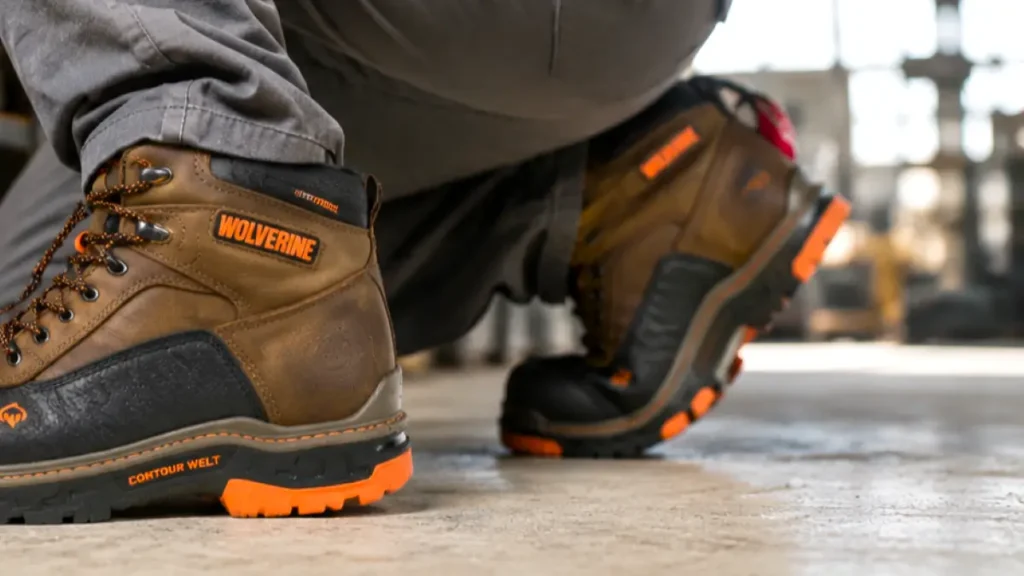
The moment you lace up the Overpass, you realize how light it is. Coming in at 1.68 lbs per boot for a size 10, it shaves off half a pound of weight per foot compared to the Timberland.
Thanks to its composite safety toe and flexible athletic construction, there is virtually zero break-in period. Tradesmen report wearing these straight out of the box for a 10-hour shift without getting a single hot spot or blister. When kneeling to grab tools from a bottom shelf, the boot is noted to bend effortlessly at the forefoot without pinching the top of the toes.
Performance on Concrete
For jobs requiring constant movement, the Overpass is easily one of the best work boots for walking on concrete. It keeps you nimble, and the built-in waterproof membrane does an exceptional job of keeping your feet dry during wet cleanup shifts or plumbing runs.
However, if your job requires you to stand in one spot—like operating a lathe or working an assembly line—the stock setup starts to fail.
After about six hours of static standing, the soft foam inside begins to pack out, and you will start feeling the cold hardness of the concrete floor creeping up into your heels.
Wolverine Overpass Pros & Cons
- Pros:
- Zero break-in time: Comfortable from the very first minute you put them on.
- Superb flexibility: The contour-welt construction allows the boot to bend naturally at the toe knuckles.
- Lightweight safety toe: The composite toe does not conduct cold like steel does in winter environments.
- Cons:
- Subpar durability: The rubber-polyurethane blend sole wears down faster on abrasive concrete floors, especially at the flex points.
- Weak stock insoles: The factory inserts flatten out quickly under heavy daily pressure.
- Tricky sizing: The toe box can feel narrow for those with wider feet, forcing you to size up.
The Secret Sauce: Do You Need the Best Insoles for Work Boots on Concrete?
Here is the practical truth about concrete-floor work: no factory insole is designed to last forever, especially when you are standing 8 to 10 hours a day on hard warehouse, factory, or workshop floors.
While the Timberland Pit Boss features a decent, dense polyurethane stock footbed that holds up well for a few months, the Wolverine Overpass relies on a softer, cheaper foam insert that quickly surrenders to gravity.
If you are serious about protecting your joints, you need to budget for the best insoles for work boots on concrete.
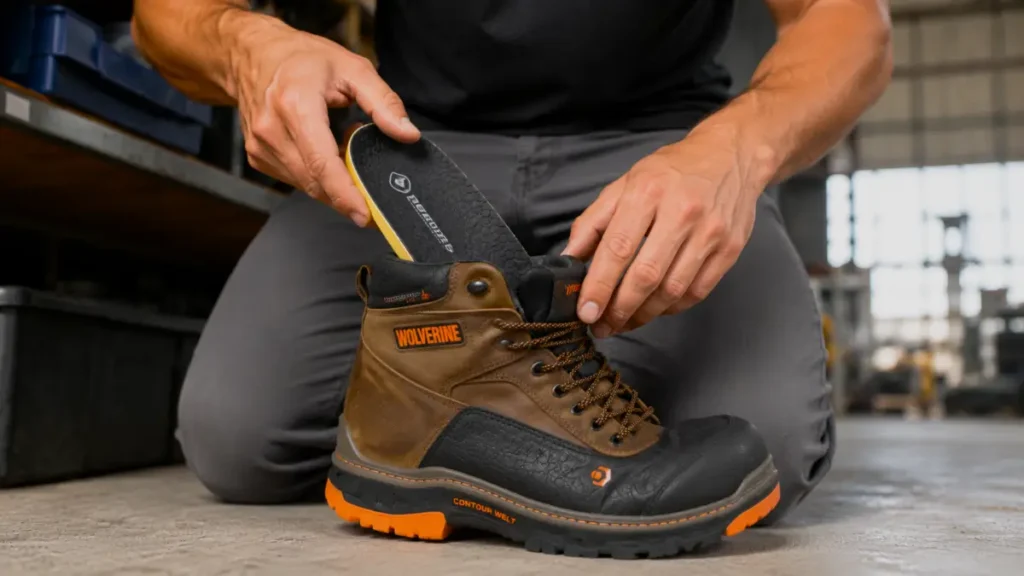
PRO TIP FROM THE SHOP FLOOR:
Do not wait for your feet to scream before upgrading your insoles.
If you choose the Wolverine Overpass, buy a high-quality aftermarket insole on day one.
Look for insoles made with dense polyurethane or medical-grade gel (like Superfeet Green,
Powerstep Protech, or Footprint Kingfoam).

Avoid cheap, ultra-soft memory foam insoles. They feel great for five minutes, but they
flatline under your body weight within a week, leaving you standing directly on the hard sole.
An aftermarket upgrade elevates the lightweight Wolverine Overpass to a whole new level of performance, giving you the flexibility of a modern boot with the heavy-duty impact protection of a traditional one.
Head-to-Head Comparison
| Feature | Timberland PRO Pit Boss | Wolverine Overpass |
|---|---|---|
| Primary Material | Heavy-duty oil-tanned leather | Waterproof leather and textile |
| Toe Protection | Steel Safety Toe | Composite Safety Toe |
| Slip Resistance | Excellent on dry/dusty concrete | Outstanding on wet/oily surfaces |
| Water Protection | Moderate (Highly water-resistant) | Excellent (Fully waterproof bootie) |
| Ankle Support | High (Rigid leather wrap) | Moderate (Flexible padded collar) |
| Sole Construction | Goodyear Welt (Stiff and durable) | Contour Welt (Flexible and athletic) |
| Expected Lifespan | 12 to 18 months | 8 to 12 months |
FAQ: What We Get Asked on the Job Site
What are the best boots for working on concrete?
The best work boots for working on concrete must balance impact absorption with long-term durability. If your day involves a mix of standing, walking, and heavy labor, the Timberland PRO Pit Boss is the most reliable tool for the job.
If your work requires a lot of crouching, climbing, or tight-space mobility, the Wolverine Overpass is the better tool, provided you upgrade the insoles.
What are the best work boots for standing on concrete?
When it comes to the best work boots for standing on concrete for 10 to 12 hours straight, the Timberland PRO Pit Boss wins hands down.
Its rigid platform and dense PU midsole prevent your foot arches from collapsing under constant, static body weight. Soft, flexible boots like the Overpass tend to sag over long hours of standing, causing heel pain by the end of the day.
What are the best work boots for walking on concrete?
The best work boots for walking on concrete are those that reduce leg fatigue and roll naturally with your stride.
The Wolverine Overpass takes this category easily. At just 1.68 lbs, it feels incredibly light on your feet, and its flexible sole design prevents your shins and calves from straining during high-step-count days.
Are steel toe boots good for concrete floors?
Steel toe boots are perfectly fine for concrete floors, but they come with two caveats: weight and temperature.
Steel adds significant weight to the front of the boot, which can increase fatigue if you walk all day. Additionally, steel toes act as a thermal bridge-if you are working on a freezing concrete slab in the dead of winter, that steel cap will suck the heat right out of your toes.
If cold weather is a factor, go with a composite toe like the Wolverine Overpass.
Do I need aftermarket insoles for concrete floors?
Yes, absolutely. Most factory work boot insoles are made of cheap, low-density foam that flattens out within a few weeks of walking on hard concrete. Investing in high-quality aftermarket insoles made of dense polyurethane or orthopedic gel is the single best way to prevent joint fatigue, lower back pain, and plantar fasciitis.
The Final Verdict
If you want a boot that feels like a cozy sneaker the moment you put it on, and you spend your day crawling, bending, and walking through wet conditions, buy the Wolverine Overpass. Just remember to toss the stock insoles and slide in a pair of high-quality aftermarket inserts to save your heels from the hard concrete.
But if you need the absolute best work boots for concrete, a rugged, heavy-duty workhorse that can survive years of daily abuse on abrasive slabs—bite the bullet and buy the Timberland PRO Pit Boss.
It will make you earn its comfort during the painful two-week break-in period, but once that leather softens up, your feet, knees, and lower back will thank you for years to come.